Showing posts with label Book review. Show all posts

Tuesday, September 27, 2011

Sometimes it pays to be a mean girl


Book review: Nice girls don’t get rich
Lois P. Frankel

While it’s a rather bland adjective, I believe that “nice” would be part of the top 10 (okay, likely 5) descriptions that my friends and family would give me, so it’s no wonder that Nice Girls Don’t Get Rich appealed to me from the library book shelf. Lois P. Frankel writes about the 75 avoidable mistakes that women make with money and offers coaching advice on how to correct them. I’ve also read her book, Nice Girls Don’t Get the Corner Office, and in both titles, she offers easy-to-implement guidance on how to become a strong-minded, savvy, and financially independent woman. 

Nice Girls Don’t Get Rich starts with a self-assessment to help the reader understand why she is not already rich. Of 42 true & false questions, I had 31 true responses so Frankel says that I’ve made a good start and need to focus on areas of difficulty in order to become fully financially independent. This book belongs in a choose-your-own-adventure series as the 75 avoidable mistakes don’t need to be read in any particular order. I first read her section on “saving and investing for future wealth” as this is the category where I had the most false responses, and then proceeded to read the rest of the book.

Frankel’s advice is not exhaustive, but her tips are quick & easy tools to put into action and clear to understand. This book also made me realize how far I’ve come in the last 15 months as I often read about a mistake that I used to make and now the thought makes me shudder (for instance, #28 First job syndrome, #33 Not budgeting, and #34 Paying bills instead of managing money). 

Here are the top mistakes that I now to plan to correct pronto:   

#41 Being risk adverse: now that I’m back in the black, I’m reluctant to part with any of my money so I’m investing in relatively safe assets. Given my young age, I can afford to bolder with my investments.

#45 Saving instead of investing: I’ve been saving up bi-weekly into my Girls Just Want To Have Funds account for the last 6 months with the intention of investing. But I just don’t know when and where to start and if I have enough dollars saved up to even start.

#42 Thinking you don’t have enough to invest to make a difference: This echos the sentiment above. I don’t notice my automatic withdrawals into my savings account so why am I not putting the deposit towards an investment instead of an account earning 0.5% interest?

#51 Not seeking financial advice: This is my definitely my biggest qualm. I think I’ve maxed out what I can do on my own (building savings accounts, maximizing my monthly budget, holding GICs, and maximizing my RRSPs), but now I need to guidance on “what’s next”. I’ve been holding back thinking I need tens of thousands of dollars to start investing, but Frankel has made me realize that I just need to get started. Her best advice is to find an advisor that fits my early stage of financial planning.

All in all, I recommend Nice Girls Don’t Get Rich to my fellow nice girls out there. It’s an ideal tool to determine your strengths and weaknesses when it comes to financial management and it has built-in roadmap to get you on your wealthy-way.

*Rosie*


Sunday, August 28, 2011

Book review: Debt-Free Forever

Debt-Free Forever
Take control of your money and your life
Gail Vaz-Oxlade

Til Debt Do Us Part is my favourite show on SLICE (ok, it’s likely my favourite show ever) and Gail Vaz-Oxlade is definitely the reigning queen of personal finance, so it was with great anticipation that I finally read her book Debt-Free Forever. The delay was due to a long waitlist at the library and while Gail misses out on the revenue from an incremental book sale, I think she’d give me bonus points for borrowing a copy for free instead.

It’s hard not to give her book an A+ rating and I did take every word that Gail wrote to heart. That being said, it wasn’t the right book for me. After finally paying off my debt last December and diligently using money envelopes to save up for my spending needes (which serves the same practice as her money jars) since last August, I’ve already adapted most of the good day-to-day money management habits that Gail endorses. At this point in my quest for financial fabulousness, I’m more interested in how to make my money work for me.

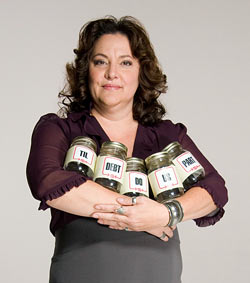
Who doesn't go shopping with their money jars in tow?
Trust me, it makes you spend less!

If you’re currently in the red or scared of the b-word, then Debt-Free Forever is the ideal no-nonsense book for you and Gail sternly walks you through a path to be debt-free forever. Grab a pen and calculator while reading this book as Gail will teach you:

1.      How to face-up to your debt
2.      How to prioritize your goals
3.      How to build a comprehensive & balanced budget
4.      How to snowball your debts to pay them off faster
5.      How to shop consciously
6.      How to plan for the long term & rainy days

There were definitely a few things that Gail motivated me to look into. The first is my credit history. While I was reading this book, CIBC contacted me to inform that they had reason to believe my personal information had been compromised and they were issuing me a new VISA. Following Gail's advice, I then put a flag on my name with Equifax Canada and TransUnion Canada so that these bureaus would have to contact me first if anyone requested a copy of my credit report… and while I was at it, I asked both agencies to send me mine. After all, Gail says it’s free to get your credit report once a year and every savvy woman should keep track of her score.

The next piece of advice was to plan like a pessimist. At the moment, I don’t have life insurance as other than my furry friends, I don’t have dependents. What I’ve never really thought about is disability insurance. I know that I am covered through work, but I have no idea how the policy is distributed or defined. Gail points out that you need to know “what’s the definition of disabled and how long you will be paid.” There is a big difference between being covered for “own occupation” (ie. the job that you are currently doing) and “any occupation”. The latter is a tricky situation as the insurance company may agree that you are no longer capable of doing the job that you had when you became injured, but because you are still capable of being a parking lot attendant they will not pay you insurance. Yikes!

Gail says that if you write your own name and those of four friends on pieces of paper, drop them in a hat and then pull one out, there is a 92% that that person will become disabled in some way. There is no way of knowing if that person could be you. But there is a way to know what your insurance policy covers and a way to plan for your future should such a dire situation occur. The first step is to request your complete and most recent disability insurance policy from your HR rep as you really cannot afford not to.

After a year of using my money envelopes, I have to admit that they are getting a pretty worn out and Gail’s jars are just that much cuter. As of today, I’ve made the switch and my Grocery & Household funds and subsequent Mad Money funds are now in masonry jars as my honourary toast to the money maven Gail.

Confession time: The Eye Candy is the one who printed those spiffy labels.
Even he knows follow Gail's rules 100%.

*Rosie*

Sunday, July 3, 2011

Book review: The Millionaire Next Door

Thomas J. Stanley, William D. Danko


I borrowed The Millionaire Next Door from my local library after seeing it on the must-read list of the great blogger Fabulously Broke in the City. FB wrote that this book changed her perspective on personal finance and wealth building and I couldn’t agree more. While the edition I read is outdated (1996), the characteristics of a millionaire next door remain relevant and revealing. In fact, this book could have predicted the recent real-estate crisis and recession in the USA due to the hyper-consumption of America’s affluent.

The biggest ‘aha’ moment for me in this book was realizing the difference between the wealthy and the affluent. They are not the same people! The wealthy are resource accumulators who invest in assets that will appreciate in value. The wealthy live below their means and focus their time on wealth creation. The affluent are high-spenders who purchase consumer goods and services at a rapid rate in order to create a rich lifestyle. 

So who is your millionaire next door? I encourage you to read this book as it’s full of real-life anecdotes, but I will create an example that I’ve taken-away from this book. Let’s consider two brothers: Bert the high income earning dentist and Ernie the modest self-employed electrician. Both are approaching their fifties, married, with 2 kids.   


Meet Bert...  

Your gut instinct is to presume that Bert is the wealthiest of the two brothers after all, he is a high-income earner, lives in a posh neighbourhood full of other professionals of similar careers, owns a 6 bedroom home, sends his 2 kids to private school, drives a BMW while his wife has a Lexus, recently took a cruise with his family and on the weekend, frequently jet boats on the lake. Bert must be wealthy to have such an extravagant lifestyle! But let’s take a step-back for a moment and consider Bert’s path to richness.

He likely spent 7 years in dental school and accumulated $100k in student loans by the time he finally graduated. When he started his dentistry, he wanted to live in a neighbourhood of like-minded professionals and he likely maxed out his mortgage rather than building a down payment towards his house. The annual property taxes likely exceed his initial down payment. Once in the neighbourhood, Bert’s wife grew concerned that that the local public schools had poor ratings for education so she made a plea to send her kids to a private school. Chances are that their parents are funding half the private school tuition for their grandchildren so while this was initially a “great deal”, Bert is now paying out of pocket several thousands of dollars a year just so his kids can keep up with their friends. As for his lavish vacation and jet boat? Credit cards, credit credits, credit cards.

While Bert wants to build for retirement, he spends less than 1 hour a month managing his money and will only spend about $300 a year for professional financial services. He works close to 60 hours a week and believes that the more he works, the better his retirement will be. Unfortunately, he is spending his $110k income faster than he earns it and as a result, Bert is living an affluent lifestyle but is far from wealthy.

Meet Ernie...

Then on the flipside, you have his brother Ernie who lives with his family several blocks away from Bert in a modest neighbourhood of semi's and apartment buildings. Ernie’s house has 3 bedrooms so his children have to share a room, and he’s been driving the same Toyota for the last 6 years while his wife just bought a “new” second-hand Volkswagon Jetta. Ernie is self-employed and has a roster of 100 customers that regularly call on his company for plumbing services. He does excellent work in a timely fashion and is constantly receiving new referrals. Ernie wears a uniform to work and blends in with his employees. He works about 40 hours a week, and likely earned $55k last year. His children go to the local public school and perhaps next year, they will drive to Florida for a family vacation at Disney World. But get this… Ernie is wealthy and likely has $800k in assets. How did he do that?

While his brother was in dental school, Ernie spent only 2 years at college and started his business right away. He had 5 years less of student loans to pay back and as a result, a 5 year start on earning a living. As a plumber, Ernie didn’t feel the need to live in a high-income neighbourhood or purchase a BMW every 2 years. After all, what would his customers or employees think if they saw a lavish house or a stylish car? They would assume that Ernie is making too much money off them and likely take their business elsewhere. Ernie has purposely chosen to live below his means and used his income for asset creation. For instance, Ernie owns several industrial properties as investments, maxes out his RRSPs each year as well as his children’s RESPs, has no credit card debt and has never accepted cash gifts from his parents. Ernie spends 1 hour a week managing his wealth and pays close to $3000 a year for professional wealth advisors and tax attorney services. At 50, he will own his house fully and will likely retire a year or two after that.

Closing thoughts  

My example of Bert & Ernie does not mean that all dentists are lavish & poor and all plumbers are modest & wealthy, but I wanted to share the difference in Bert & Ernie’s mindset. Millionaires don’t go around buying jet boats and designer suits as the The Millionaire Next Door reveals that a millionaire likely drives a used-vehicle and has never paid more than $80 for a pair of jeans. Millionaires are constantly looking for assets that will appreciate, are committed to creating wealth and eager to protect the value of their wealth while they seek to minimize frivolous spending on consumer goods. This is an informative read on America's millionaires, their lifestyles, how they created their wealth and how they invest. The material is easy to absorb and it is definitely thought-provoking. At the end of the day, I'd rather be wealthy than appear affluent.  

My key take-aways from this book:
1.      Revisit my goal of finding a personal financial advisor. I think I need to find a personal wealth advisor, but I’m not sure where to start looking.
2.      Start evaluating my net-worth alongside my monthly budgets.
3.      Continue to live below my means and avoid the pressure of keeping up to keep up with the Jones.


*Rosie*

Saturday, April 16, 2011

Be your own sugar daddy by making your cash work for you

Rich Dad, Poor Dad
Robert T. Kiyosaki with Sharon L. Lechter

I just finished reading Rich Dad Poor Dad and I highly recommend it for my fellow yuppies who are also just starting out in their professional lives and quickly trying to live the dream (or at least, appear to be living the dream). While the investment strategies in this book focus on real-estate, there are many simple lessons that changed the way I think about my “assets”. The bi-line of the book describes RDPD as “what the rich teach their kids about money – that the poor and middle class do not.” Kiyosaki shares the stories of his 2 dads: one who told him to work hard and the other who told him to have his money work hard for him.

The latter lesson is what separates the “rich dads” from the “poor” ones. The rich dads have the returns on their assets pay for their Porsche and fancy houses, while the poor dads work hard to get pay raises to buy the same things. The difference is that the rich dads are building portfolios of assets, while the poor dads have expenses.

Kiyosaki explains the trap that many Yuppies fall into and terms it the “Rat Race” : you get your first job, your first condo, furnish it, then fall in love, move in together, thinking you know have twice as much money available you buy a bigger house and a car only to discover your life is eating away at your cash flow so you work harder to get a promotion, only to see half your earnings go to taxes and then at the end of the day, you’re stressing over payments… but hey, at least you’re living the dream.

This book helped to remind me of the basic accounting principles I learned in year 1 university: assets = I own them vs. liabilities = I owe someone else. I was reading this book at the same time that my Eye Candy and I drove away from the Mazda lot with our new CX7 and I was so proud to have “purchased” my first car. Only, I haven’t really purchased it – it’s an expense that I’m paying for over the next 4 years and from the second we drove it off the lot, our vehicle lots its value.

My real “assets” are my RRSPs and my investments and I should use these assets as revenue generators. Kiyosaki encourages readers to think of their assets as the “business that you’re in” and your day-to-day jobs as profession. It’s the success of your business that will get you out of the Rat Race… not your day job.

My key take-aways from this book:
  1. To pro-actively manage my assets: pay myself first
  2. Build my financially literacy: take time to learn how to invest
  3. Instead of thinking, “I can’t afford that”, ask myself, “How can I afford it”?
  4. To recognized my expenses as a cost of life… not part of my net worth 
  5. Work to learn 
*Rosie*

Saturday, February 12, 2011

Bedside financial reading that won't put you to sleep

I've had some private Facebook messages requesting me to share some tips & tricks on elminating debt. This means I have more readers than followers! While I started this blog because I'm looking to figure out my finances now that my debt is wiped clean, there are some must-reads that I would recommend for every girl looking to have more funds.


The Smart Cookies' Guide To Making More Dough: How Five Young Women Got Smart, Formed A Money Club, And Took Control Of Their Finances
Andrea Baxter

This came recommended by my BFF /fellow Sporty Spice. It gave me the motivat
ion to open my Visa and take control of my finances because I finally realized that I could have any life I wanted if I took the time to manage my money and think about my long-term goals. It is written from the perspectives of 5 ladies who all have interesting careers (PR, marketing, social work) and are at different stages in their relationships (single, divorced, engaged), but were charging up their debt in an effort to maintain an appearance or handing over their financial control to the men in their lives. Who can't relate to that? By sharing their financial situations with one another, the women found motivation to pay off debt and establish money-managing plans for their goals. The book includes budgeting techniques, tips on being a smart spender, and advice on how to make more "dough".

The advice on budgeting seems strict at first as it encourages compartmentalizing all upcoming expenses and paying in cash using "money envelopes". None the less, last July I had nothing to lose so I opened up my Excel, planned my first 4-wk rolling budget and started my envelopes: e.g. household purchases ($100/month); groceries ($120/week); and fun money ($80/week). Obviously the fun money was my favourite envelope! After taking the time to budget all my upcoming expenses and debt payments, I determined that I could afford $80/week for fun. I use the cash for anything I want - coffee at work, dinner out, a botte of wine, a fun nailpolish, or a little dress from Winners. The trick to the "fun money" is to establish an amount that you can afford and not to feel guilty about spending money it. After all, you're taking the time to make sure everything else is paid off so this is a small personal indulgence that lets you feel empowered about your shopping and not feeling deprived by your budget.

The Smart Cookies Guide is relatable and is an excellent first-step to becoming financially fabulous. It is also Oprah-approved as one of her favourite things. The bonus? The women are Canadian so all the financial tools that they share are practical for us Canadian chicks! The hard-cover edition is a bargain book at
Chapters right now for $6.99, so I'd classify this book as an amazing investment.


The Wealthy Barber Gold Edition
David Chilton

My Eye Candy gave me this book over two years ago, but it took some time for me to actually pick it up. After all, financial planning is not the most exciting topic, but I wish I hadn't waited so long. I think this should be mandatory reading for every student and the younger the better. It is now my favourite gradution gift for friends & family.

While it is slightly hokey-pokey at parts, David Chilton shares stories of his trip to see the Roy - the local wealthy barber who cuts your hair and if you're lucky, dispenses personal financial planning advice. The book is easy to read and the financial strategies are even easier to implement. It's common sense for financial planning and as I went through the chapters, I found myself taking action. I now take 10% off my gross income automatically off my paycheck and it directly goes into my RRSP. Since I started this 7 months ago, my RRSP value has doubled what it took me 3 years to save up! It is almost shameful to admit that! But the best part? I don't even notice the impact in my day-to-day life of putting away 10% into my RRSP, but I'm sure the fabulous 65 year old version of myself is already thanking me for maintaining her wonderful lifestyle.

Another tip that I put into action was the life-insurance. For $50 a month, I was putting away money into a huge life-insurance policy. Ummm... why? The truth is because when I started my job, I just kept signing forms and filling in options because I thought that was what every good first-time full-time worker does. But when I thought about it, at this point in my life, I don't need to spend money on life insurance. I am not married (yet... hint, hint), nor the sole bread-winner in my relationship, and I have no children. For now, I am better off taking the money and putting into another investment.

I plan to reread The Wealthy Barber in the next month as there were parts that initially went over my head about investing simply because I was so concerned about paying off my debt that the timing was not right to implement. And like Smart Cookies, this book is Canadian based. So if you've not read The Wealthy Barber yet, let me know when your birthday is coming up.


Bitches on a Budget
Rosalyn Hoffman

I ordered this book online after seeing it in-store and decided it would be a witty read. Hoffman did not disappoint! It is the chick lit of personal finance. While the Canadian economy did not have the same recession crisis as our USA neighbours, saving money is always in style. There are tips for being a smart shopper like when to splurge on the items based on the seasons and retailers to keep on your shopping circuit (sidenote: I am so excited that
Target is coming to Canada soon as this seems to be the mecca of every recessionista) and I found the tips to be new and relevant... not just the same old "skip your coffee for $3 a day and you'll have a $1000 at the end of the year". (While I respect the latte-factor tip, I genuinely enjoy my $1.25 Tim Horton's tea as it's a chance to "network" with my colleagues and escape my cubicle life for at least 10 minutes a day.)

Bitches on a Budget also gives ideas on how to maintain your wonderful lifestyle no matter what your budget - how to decorate your nest, what to order when you go out for a night on the town that's healthy & thrify, how to pamper your pooch without giving her a wardrobe more impressive than your own, and encouragement to get fit while keeping your bank account in shape. All in all, it is a fun-yet-frivilous-but-financially-fabulous read. I encourage every girl to unleash her inner bitch on a budget!


I am currently reading
Does This Make My Asets Look Fat? A Woman's Guide to Finding Financial Empowerment and Success by Susan Hirshman which is all about finding the right mix of investments in your portfolio. It's on my beside table right now so expect a review soon... and my adventure in buying some assets.